Original written and art work, site design and layouts:
© Caer Australis 1995 - 2020
Authors, designers and publishers: John and Scott Rhys Jones.
Other work used with permission if possible, in public domain and referenced in any case when possible.
Any enquiries, please email john.rhysjones at caeraustralis.com.au
Caer Australis comes to you from Glen Innes,in the
Glen Innes Highlands of northern NSW, Australia, home to the annual Australian Celtic Festival
| Last Updated August, 2020 |

Celtic Traditions, Myth and History
A view from Glen Innes Highlands, NSW Australia
Southern Samhain: Summerend 2021

Celebrating for 25 years - since 1995
Croeso - Fáilte - Welcome


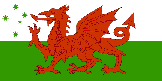
Caer Australis presents an exploration and celebration of traditions born in the Heroic age and recorded for centuries since throughout the Celtic world.
We celebrate The Celtic Fire Feasts held on the cross-quarter times mid-way between the solstices and equinoxes, and present an investigation on the origins and workings of The Celtic Calendar, from ancient Gaul showing that the great two-fold division of the Celtic year opens at Samon in Samhradh the summer, and followed six months later by Giamon in Geimhreadh the winter, such that Beltaine marks the start of the tradtional Celtic year. Follow the remarkable cultural continuity that links the sweep of northwest Europe, in which Cétemain, that is cét-sam-sin, continued the traditional Celtic month of Samon into the Julian calendar of Ireland and names the season it heads, that is, Samrad: the summer.
Caer Australis celebrates the The Southern Seasons and looks at Australian perspectives of the Celtic Feasts and Calendar. We also aim to link to Australian Celtic Links with connections to Australian Celtic societies and clubs, musicians and artists, and websites for Australian Celtic cultural festivals.
We celebrate Celtic song and poetry in The Grove, and mythology and thoughts on The Gorsedd. We present an ancient history using ancient sources and presenting a Celtic perspective from the time of Brennus to that of Boudicca in Conquest, and explore to meet King Arthur in The Arthur Project.
Today Celtic people abound all over the globe, and bring with them the knowledge that throughout its history, the Celtic culture has expressed through its deities, myths and languages a most powerful ideal - the Celtic hero - who has met the challenges of the ages, full of tragedy mixed with unyielding hope. The modern Celtic homelands are secure and increasingly independent, the languages flourish, and a desire to know what once was is driving forward the impetus for what is yet to be.
To understand the past so that we may meet the future with knowledge and wisdom is a worthy challenge, and it is worth seeking with honesty, passion and integrity. Since 1995 Caer Australis has enjoined with others in this challenge in our celebration Celtic traditions and our reasoned analyses of some popular antiquarian and modern ideas.
In exploring the song, myths and history of the Celts, we join those who strive to find the magic and meaning of the powerful literature of an enduring culture.
"Roman lust has gone so far that not our very persons, nor even age or virginity, are left unpolluted.
But heaven is on the side of a righteous vengeance; a legion of Romans which dared to fight has perished; they will not sustain even the din nor less our charge and our blows.
If you weigh well the strength of the armies, and the causes of the war, you will see that in this battle you must conquer or die!"
- Boadicca (Tacitus, Annals, 14.35).
Australian Celtic & Folk Festival websites
 St Patrick's Day Parade March Sydney CBD |
 National Folk Festival April Canberra, ACT |
 Bundanoon Highland Gathering April Bundanoon, NSW |
 Australian Celtic Festival May Glen Innes, NSW |
 Berry Celtic Festival May Berry, NSW |
 Kernewek Lowender May Yorke Pen., SA |
 National Celtic Festival June Portarlington, Vic |
 Kilmore Celtic Festival June Kilmore, Vic |
 Abbey Medieval Festival July Redcliffe, Qld |
 Balaklava Eisteddfod July Balaklava, SA |
 Kapunda Celtic Festival September Kapunda, SA |
 Nanga Music Festival October Dwellingup, WA |
 Fleurieu Folk Festival October Wilunga, SA |
 Beechworth Celtic Festival November Beechworth, Vic |
 Scottish Highland Gathering November Castle Hill, NSW |
 Celtica Festival December Port Adelaide, SA |
Content Guide to Caer Australis

The Grove:
Welcome to the Grove
Song of Amergin
To August
An Gevren - The Link
Summer in the Grove
 Featuring the works:
Summer Has Come
The Salmon of Knowledge
Arrival of the Giolla Dacker
Song of Summer
Mac ríg
The Yellow Bee
A Rose by Another Name
May
Arberth Hill
Summer
Original works:
Olwen
Green Bough
Green
The Mayfly
Y Ddraig Goch
The Little Prince
Winter in the Grove
 Featuring the works:
A Song of Winter
Winter
Summer is Gone
Saman's Day
The Feis of Tara
Samhain
Chant of the Fairy Maiden
Clear Winter
Original works:
Summer's End
She
The Fallen
Knowing Nothing
The Acorns
Saints in the Grove
 Featuring the works:
St David - Llandewi Brefi
St Piran - On the Millstone
St Patrick - The Conversion of King Laoghaire's Daughters
The Paschal Fire
St Columba - My Druid is Christ, the Son of God
St Brigit - I Should Like
Blathmac, son of Cú Brettan
The Fate of the Children of Lir
Goddesses in the Grove
 Featuring the works:
Danu Mother of the Gods
Brigit
Isis Queen of Heaven
Badb's song
Minerva of the Gauls
Arianrhod
The six gifts possessed by Emer
Modron mother of Mabon
Mary mother of Christ
Olwen - White Track
The fair woman, Bé Find
The great Queen, Rhiannon
Pisces' Babies
Rowan Berries in the Grove
Featuring the works:
Soma of the Celts
Glyn Cuch - The Red Valley
Gwydion obtains the swine of Annwn
Grania declares her heart to Diarmait
The Quicken Berries of the Forest of Dooros
The Dream of Macsen Wledig
The Gorsedd:
Welcome to the Gorsedd
The Fair Woman
Mabon ap Modron
Gwern in the Fire
Celtic Origins
River and the Well
Samhain is not the Celtic New Year
Last Witch Trial - P.W Joyce
"Grows an oak upon a steep,
The sanctuary of a fair lord;
If I speak not falsely,
Lleu will come into my lap"
- Gwydion, Mabinogi of Math ap Mathonwy
The Grove:
Welcome to the Grove
Song of Amergin
To August
An Gevren - The Link
Summer in the Grove
Featuring the works:Summer Has Come
The Salmon of Knowledge
Arrival of the Giolla Dacker
Song of Summer
Mac ríg
The Yellow Bee
A Rose by Another Name
May
Arberth Hill
Summer
Original works:
Olwen
Green Bough
Green
The Mayfly
Y Ddraig Goch
The Little Prince
Winter in the Grove
Featuring the works:A Song of Winter
Winter
Summer is Gone
Saman's Day
The Feis of Tara
Samhain
Chant of the Fairy Maiden
Clear Winter
Original works:
Summer's End
She
The Fallen
Knowing Nothing
The Acorns
Saints in the Grove
Featuring the works:St David - Llandewi Brefi
St Piran - On the Millstone
St Patrick - The Conversion of King Laoghaire's Daughters
The Paschal Fire
St Columba - My Druid is Christ, the Son of God
St Brigit - I Should Like
Blathmac, son of Cú Brettan
The Fate of the Children of Lir
Goddesses in the Grove
Featuring the works:Danu Mother of the Gods
Brigit
Isis Queen of Heaven
Badb's song
Minerva of the Gauls
Arianrhod
The six gifts possessed by Emer
Modron mother of Mabon
Mary mother of Christ
Olwen - White Track
The fair woman, Bé Find
The great Queen, Rhiannon
Pisces' Babies
Rowan Berries in the Grove
Featuring the works:
Soma of the Celts
Glyn Cuch - The Red Valley
Gwydion obtains the swine of Annwn
Grania declares her heart to Diarmait
The Quicken Berries of the Forest of Dooros
The Dream of Macsen Wledig
The Gorsedd:
Welcome to the Gorsedd
The Fair Woman
Mabon ap Modron
Gwern in the Fire
Celtic Origins
River and the Well
Samhain is not the Celtic New Year
Last Witch Trial - P.W Joyce
Caer Australis presents...
As adjuncts to the main Caer Australis site, where the focus is on Celtic culture, are two historical websites -
The Arthur Project, which presents an introduction to the Arthurian legends and the historical endevours to penetrate the Dark Age of Britain; an overview of the stories and Arthurian romances; and the power of the legend today.
The Arthur Project - Home
 The Time & Place
Arthur Pendragon
Romances of Arthur
Historical Arthur
The Birth of Arthur
Arthurian Themes Today
On-Line Resources
References
AP Contact Form
Conquest of the Celts, which presents a comprehensively referenced and documented account of the ancient world of the Celts from the earliest of historical times. Events through four and a half centuries of are examined, the conflict with the emergent Roman Republic and later the Empire. From Brennus, through to Vercingetorix, Cunobelinus and Boudicca, this is the rich history of the Heroic Age of the Celts.
Conquest - Home
 The Heroic Age
Gallic War
Vercingetorix
Cunobelinos
Britain
Boudicca
On-Line Resources
References
Conquest Contact Form
The Celtic Fire Feasts:
"Samrad didiu ríad reites grian, is and is mo doatne a soillsi;
Cetsoman .i. cetsámsin .i. cétlúd síne samraid;
Gam quasi gamos isin greic, nouimber .i. in mí gaim iar samuin"
- Sanas Cormaic (9th century)
The Celtic Fire Feasts - Introduction
Beltaine
Lughnasa
Samhain
Oimelc
The Southern Seasons Celtic Fire Feasts
In the Southern Hemisphere, the seasons are off-set by half a year, and the southern Celtic Summer begins at the time of Samhain in the North. In this section, the Celtic response to the year in the Southern Hemisphere is explored.
The Celtic Calendar:
"Now when at intervals of thirty years the star of Cronus, which they call 'Night-watchman', enters the sign of the Bull, they, having spent a long time in preparation for the sacrifice, choose by lot a sufficient number of envoys, while those who have served the god together for thirty years return home"
- Plutarch (De Facie, AD75).
The Celtic Calendar - Introduction
The Celtic Calendar - Correspondences to the Gregorian year
| Samon | Duman | Riuros | Anagantios | Ogronnos | Cutios |
| Ciallos | Giamon | Semiuisonna | Equos | Elembiuos | Edrini | Cantlos |
| SAMON Apr --> May Beltaine |
"Summer" (*samo-, samrad) |
GIAMON Oct --> Nov Samhain |
"Winter" (*gaimo-, gaimred) |
| DVMAN May --> Jun early summer |
"The World" (dumno-, domhan) |
SIMIVIS Nov --> Dec early winter |
"The Source" (sem + uis) |
| RIVROS Jun --> Jul summer solstice |
"The New King" (rix, ri + úr) |
EQVOS Dec --> Jan winter solstice |
"Horse" (*ekvos, echu) |
| ANAGAN Jul --> Aug Lughnasa |
"Unwonted" (an + gant, ingantach) |
ELEMBIV Jan --> Feb Imbolg |
"Nurturing Life" (ailim + *bivo-s) |
| OGRON Aug -->Sep late summer |
"Colder" (*ogro-, oer, fuar) |
EDRINI Feb -->Mar late winter |
"Warmer" (aedh) |
| CVTIOS Sep --> Oct autumnal equninox |
"Cover" (cuddio) |
CANTLOS Mar --> Apr vernal equinox |
"Songs" (cantla, canu) |
 Division of the Year
Ar is dé roinn nobid for an mpliadain and
.i. in samrad o beltine co samfuin;
in gemred o samfuin co beltine.
For two divisions were formerly on the year, namely, summer from Beltaine the first of May to Samuin, and winter from Samuin to Beltaine.
- from Tochmarc Emer
CAER AUSTRALIS: Original work and design all pages © Caer Australis 1995 - 2020: From the Glen Innes Highlands, NSW Australia